
UNESCO World Heritage · 40 min from Lisbon
The Romantic Hills of Sintra
38.8029° N · 9.3817° W
A forested hillside above the Atlantic where Portuguese kings and English romantics built palaces into the mist. Pena, Regaleira, Monserrate and the Moorish castle — all within a single private day tour from Lisbon.
Private tours and day trips to Sintra from Lisbon
- 30 km from Lisbon
- Palaces, gardens & forest
- UNESCO listed since 1995
Palaces & estates
Six palaces on one hillside
Sintra’s palaces span five centuries and four architectural vocabularies, all within a couple of kilometres of each other. No other place in Portugal holds so much in so small a space.
Pena uses timed entry and sells out days ahead in summer — book the earliest slot you can. A private day tour can cover Pena and two of the others comfortably; all six need two days.
-
01 1842–1854 · Romanticist
Pena Palace
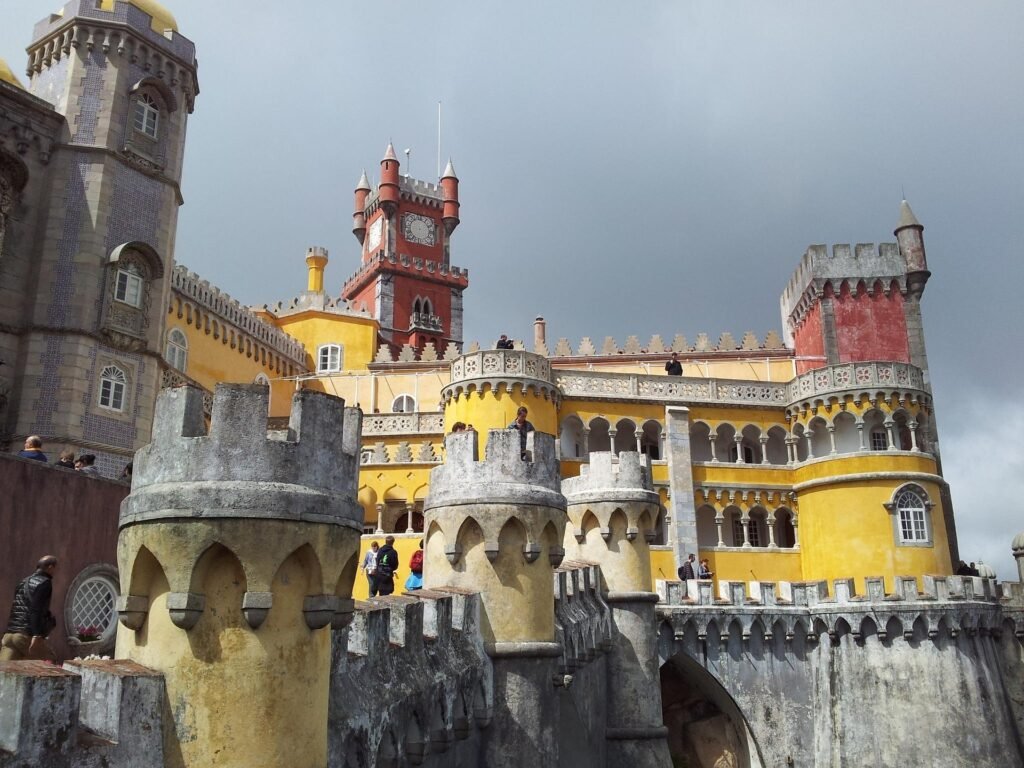
Built by King Ferdinand II on the ruins of a sixteenth-century Hieronymite monastery, high on the second-highest point of the Serra. A Romanticist fantasy of yellow and red towers, domes and crenellated walls, with the original monastery cloister preserved at its heart. The most visited monument in Sintra.
What to see The Triton archway, the Queen’s Terrace, the Manueline cloister of the original monastery, and the view across the Moorish Castle to the Atlantic.
-
02 1904–1910 · Symbolist
Quinta da Regaleira
Built by the Brazilian-Portuguese millionaire António Augusto Carvalho Monteiro with the Italian set designer Luigi Manini. A house and garden loaded with Masonic, Templar and esoteric symbolism — grottoes, tunnels, follies, and the two Initiation Wells. The most atmospheric site in Sintra, and the one people remember.
What to see The Initiation Well — nine landings spiralling down to a tiled floor — the tunnels beneath the gardens, the Chapel of the Holy Trinity, and the Regaleira Tower.
-
03 8th–9th c. · Moorish
Moorish Castle
A Moorish fortification built along the ridgeline above the town, taken by Afonso Henriques in 1147. The walls run for roughly 450 metres, and walking the full length of them gives the widest view in Sintra — down over the town, up to Pena, and out to the Atlantic.
What to see The walk along the walls, the Royal Tower at the centre, and the small twelfth-century church of São Pedro de Canaferrim inside the outer walls.
-
04 14th–16th c. · Medieval
Sintra National Palace
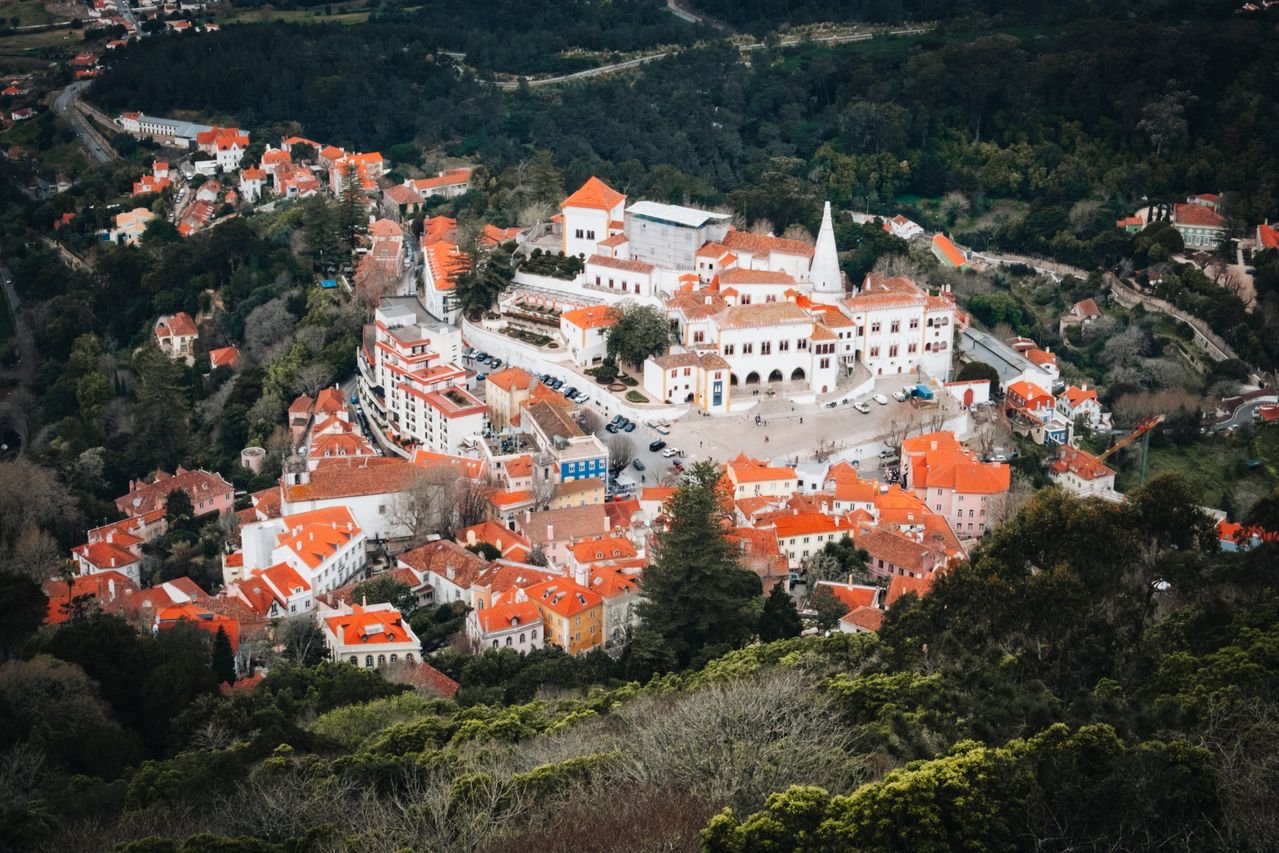
The best-preserved medieval royal palace in Portugal, and the only one of the six down in the town itself rather than up on the hill. Used by the Portuguese court for six centuries. The two enormous conical chimneys over the kitchen have become the symbol of Sintra.
What to see The kitchen with its two chimneys, the Swan Room, the Magpie Room, the Coat of Arms Room with its blue-and-white tile, and the courtyards with their sixteenth-century azulejos.
-
05 1858–1863 · Moorish Revival
Monserrate Palace
Rebuilt for the English millionaire Sir Francis Cook by the architect James Knowles, on the site of an earlier estate that Byron had stayed in. Its outline is more Indian and Arabic than Portuguese — filigree arches, a dome, loggias — and the gardens below are a proper botanical collection laid out in a valley with lakes and a fern garden.
What to see The filigree arches of the façade, the domed central hall, and the fern valley and botanical collections in the gardens below — quieter than Pena and often the surprise of the day.
-
06 1783–1787 · Neoclassical
Seteais Palace
A neoclassical palace built for the Dutch consul Daniel Gildemeester and expanded by the Marquês de Marialva. Now a five-star hotel, so the interior is not open to day visitors — but the gardens and the triumphal arch between the two wings are, and the arch frames one of the most photographed views of the Sintra hillside.
What to see The triumphal arch over the road between the two wings, the formal gardens, and the hillside framed through the arch itself.
The Sintra private tour covers Pena and the two or three others you most want to see, in whichever order suits your group and the day’s weather.
See the Sintra tour →UNESCO World Heritage
The Sintra hills, listed as a cultural landscape
In 1995 UNESCO inscribed not a building but the whole Serra de Sintra — the forest, the palaces, the estates and the town as a single entity. It was one of the first European sites listed in that category.
Listing details
- Inscribed
- 1995
- Category
- Cultural landscape
- Criteria
- ii · iv · v
- Core area
- 960 ha
- Buffer zone
- 3,600 ha
UNESCO does not list Sintra as a monument. It lists the whole range of hills — the granite ridge, the Atlantic forest that covers it, the palaces and quintas set into the slopes, and the town at the foot of them — as one continuous cultural landscape.
A cultural landscape is a UNESCO category introduced in 1992, and it recognises the combined work of nature and people rather than one or the other. Sintra was among the first European sites inscribed in that category, and it fits the definition unusually well: the forest that covers the Serra is itself a human creation, planted and managed over centuries to frame the palaces that sit inside it. The hills look wild; they have been shaped for six hundred years.
The citation rests on three things: the way the palaces and estates represent a distinct Portuguese Romanticism that drew on Gothic, Egyptian, Moorish and Renaissance sources; the survival of an intact eighteenth- and nineteenth-century landscape of parks, gardens and quintas; and the way the whole hillside forms a single designed composition rather than a collection of separate buildings.
The designation means the hillside is protected — which is also why access to some of it is restricted, and why Pena in particular uses timed entry. Visit early, book ahead in summer, and the landscape the listing was written about is still the one you walk through.
Ready to see Sintra at your own pace?
Two private day tours from any Lisbon hotel — the Sintra hills on their own, or Sintra and the Atlantic coast in one day.